
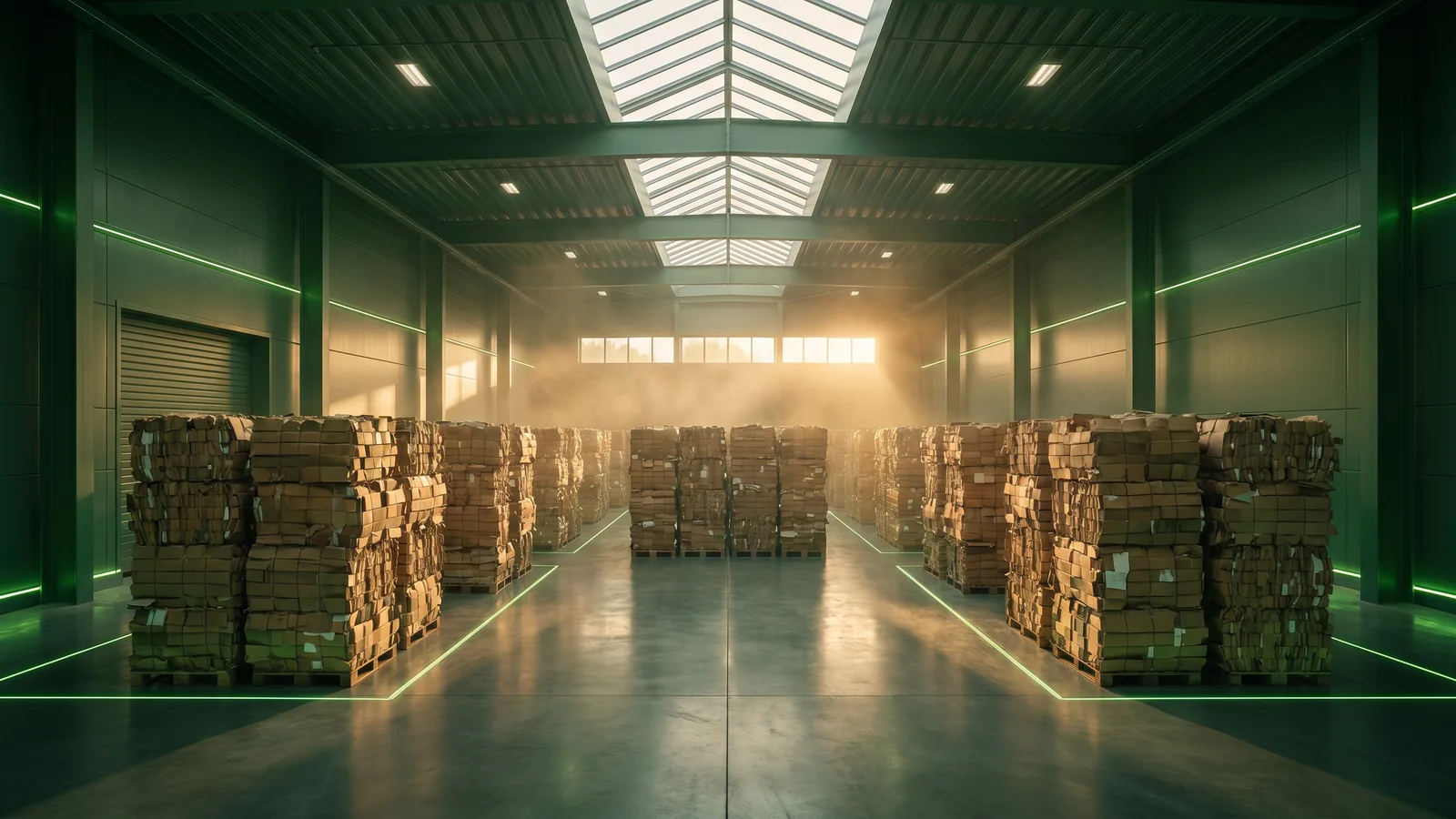
Cardboard as a raw material
Clean, dry cardboard is almost fully recyclable and a sought-after raw material. Well separated at source, it yields a high-grade stream and lowers your disposal costs. IAM provides the right collection equipment, an efficient schedule and a route to certified paper mills.
How does it work?
Intake & equipment
We map your volume and place suitable containers or a baler.
Separate collection
Cardboard is collected separately on a schedule that fits you.
Recycling
The cardboard goes to certified paper mills as raw material.
Reporting
You receive insight into collected volumes and savings.
What determines the price of cardboard collection?
Cardboard is one of the few waste streams that can generate revenue instead of costs. The market price for waste paper and cardboard moves with demand from paper mills, and the net price you pay or receive depends on a few levers: volume, quality, container type and logistics. Offering clean, dry, baled cardboard yields the most.
Volume & frequency
Larger, regular volumes lower the cost per collection. A compactor or baler often pays off even at medium volumes.
Quality of the cardboard
Dry, clean cardboard fetches the highest paper price. Contamination with plastic, foam or moisture immediately lowers the value.
Container & location
Roll container, compactor or bale storage — the right equipment in the right place saves handling, space and transport movements.
At intake we first look at your cardboard stream itself: how much is released, how clean is it and how much space is there for storage or a baler? We then work out two or three scenarios — for instance loose roll containers versus a baler — including the current paper price. You see upfront what each option costs or yields net, and choose with confidence.
Frequently asked questions
Does IAM supply the collection equipment?
Yes. Depending on your volume we supply rolling containers, roll containers or a baler, and arrange placement and exchange.
How should the cardboard be presented?
Clean and dry, free of plastic, foam and other contamination. That keeps the stream high-grade and cheaper to process.
Can cardboard be combined with other streams?
Yes. We are happy to combine cardboard with other commercial waste streams in one collection.
Is there a compensation for cardboard?
For larger, clean volumes a compensation is often possible. We assess this per situation and market price.
Can business cardboard generate revenue?
Yes. With sufficient volume and clean quality you receive the current market price for waste paper — settled transparently in the reporting.
Must the cardboard be supplied dry?
Yes, wet cardboard loses quality and value. Choose covered storage or a closed container.
What must not go with the waste paper?
Contaminated or greasy cardboard (such as pizza boxes), laminated paper, foam and films. Those belong with residual waste or a separate stream.
Is a baler worthwhile for my business?
Often already at a few containers of cardboard per week: baling saves space and transport and yields a higher paper price per tonne. We run the numbers for you.