
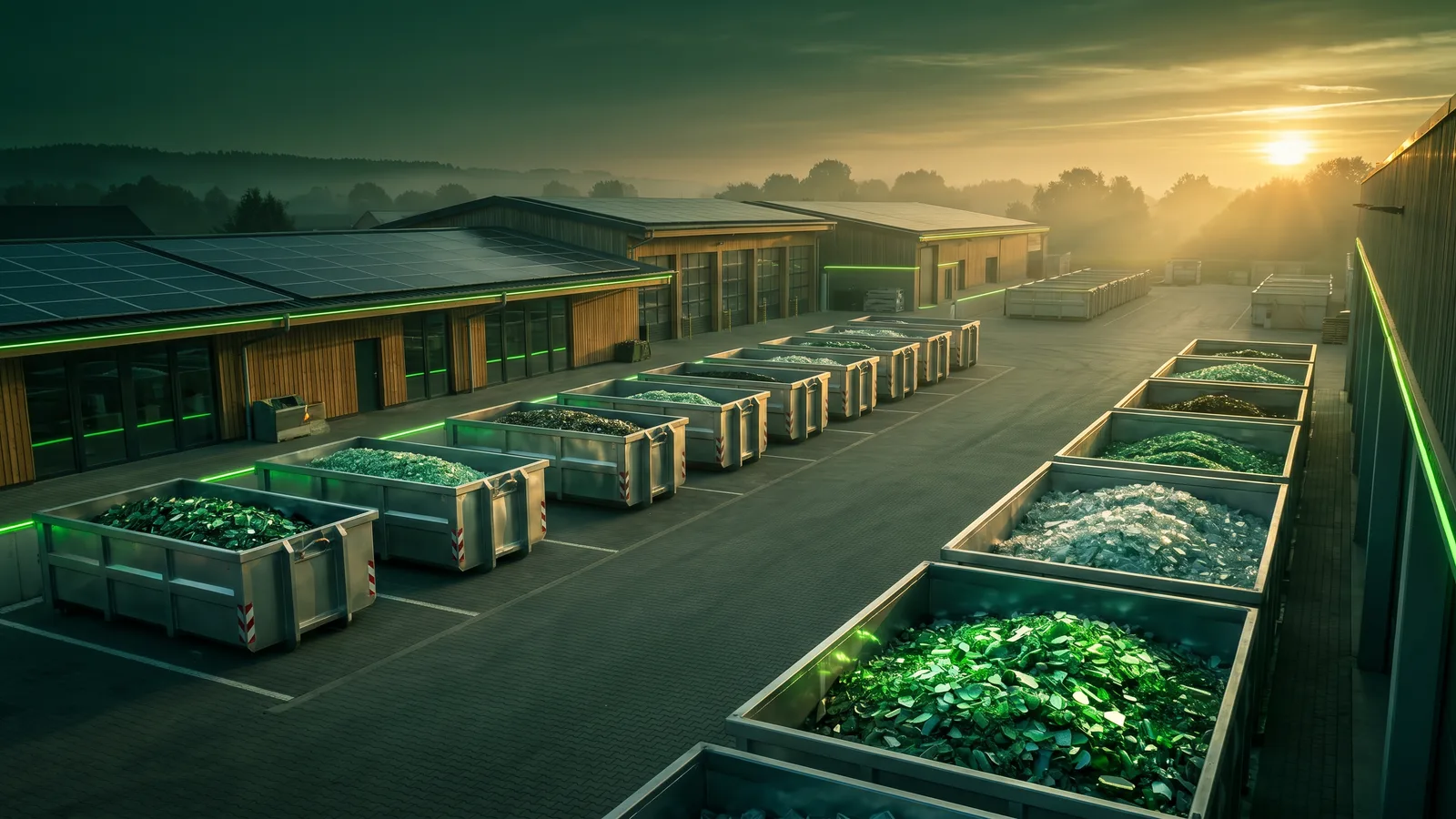
Packaging glass
Bottles and jars from production, retail and hospitality.
Glass can be recycled again and again without loss of quality. Separated by type at source, it yields a clean raw material for new glass. IAM supplies suitable collection equipment, arranges safe collection and routes the glass to certified recyclers.
Bottles and jars from production, retail and hospitality.
Window and construction glass from renovation and industry.
Mixed glass from hospitality and events, safely collected.
Glass is endlessly recyclable without quality loss, and separate collection is mandatory for many businesses once volumes allow. Costs are mainly driven by the type of glass, the volume and the logistics: packaging glass from hospitality needs different equipment than flat glass from renovations. Well-separated glass is cheaper to process and keeps the recycling loop closed.
Packaging glass, flat glass and wired glass each have their own processing route — mixing lowers the batch value.
From bottle bank to container: the right size and a fitting emptying frequency prevent unnecessary transport costs.
An easily accessible setup makes emptying faster and cheaper — especially in city centres and on tight sites.
We start with a short survey: which glass is released, in what volumes and where does it sit? Based on that we advise the right container and emptying frequency and set up the route to the glass recycler. For hospitality and retail we often combine glass with other streams in one schedule — saving transport movements and therefore cost.
Yes. We supply suitable, safe containers per glass type and arrange placement, exchange and collection.
Where possible, yes — separating packaging glass and flat glass keeps the stream high-grade. We advise on the best set-up for your situation.
Yes. We are happy to combine glass with other commercial waste streams in one collection.
Yes. From IJmuiden we collect business glass from companies throughout the Netherlands.
For most business situations mixed packaging glass suffices. Colour separation can raise the value with large, constant volumes.
Ceramics, porcelain, mirrors, heat-resistant glass (oven dishes) and fluorescent tubes. They disrupt recycling or are hazardous waste.
Businesses must separate waste streams where reasonably possible. With structural glass volumes that means separate collection in practice.
Yes. Glass is kept separate but collected within the same schedule as, say, cardboard and residual waste — one planning, one report.
The glass goes to a glass recycler, where it is cleaned of contamination, sorted and crushed into cullet. That cullet replaces sand and soda in the furnace: every tonne of recycled glass saves raw materials and energy. Glass can repeat this loop endlessly without quality loss — one of the most circular streams there is.